


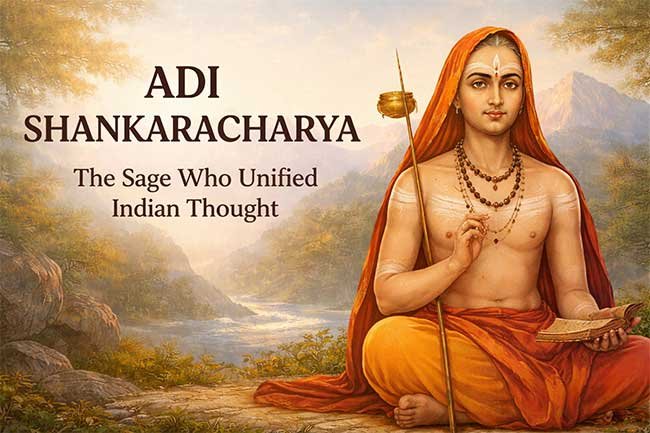
Adi Shankaracharya was born in the village of Kalady in present-day Kerala, India. His parents were Shivaguru and Aryamba, who were devoted to spiritual life and longed for a child. Traditional accounts tell that Shankaracharya’s birth brought joy and hope to his family, and he was named Shankara, meaning the one who brings prosperity. Although there are different views on exactly when he was born, it is commonly believed — based on many traditional sources — that he lived about twelve hundred years ago and completed his work in a relatively short life span.
As a child, he was known for his sharp mind and deep interest in spiritual questions. After the death of his father at a young age, his mother played a key role in his early education. At the age of eight, his strong desire for liberation and spiritual knowledge led him to leave home in search of a guru who could guide him on the path of wisdom.
Table of Contents
Meeting His Guru: Govinda Bhagavatpada
After walking nearly two thousand kilometres, the young Shankara reached the banks of the river Narmada, where he found his teacher, the sage Govinda Bhagavatpada. Under his guidance, Shankaracharya delved deep into the Vedic scriptures and mastered them. He served his guru faithfully for several years, gaining a deep understanding of spiritual knowledge.
Govinda Bhagavatpada recognized Shankara’s brilliance and trained him in Vedanta philosophy. At about the age of twelve, his guru felt he was ready to write commentaries on major scriptures and encouraged him to explain their deeper meanings. Shankara’s early studies under his teacher laid the foundation for the profound philosophical works he would later compose.
Shankaracharya’s Teachings: Advaita Vedanta
Adi Shankaracharya is best remembered for teaching Advaita Vedanta, a philosophy that explains the unity of the individual soul (atman) and the ultimate reality (brahman). According to this view, the world of forms perceived by our senses is temporary, while the underlying reality is one and unchanging. He summarized this truth in clear, simple terms and used logical reasoning to show that ignorance of this unity is the root cause of human suffering.
His statement “Brahman Satyam Jagan Mithya” conveys that eternal reality (brahman) is the only truth, while the world we see is transitory. Through self-inquiry, meditation and study, a person can transcend ignorance and experience oneness with the universal Self.
Major Works and Writings
During his short life, Shankaracharya wrote commentaries on the major Vedantic texts, such as the Upanishads, Bhagavad Gita, and Brahma Sutras. These commentaries remain some of the most respected works in Indian philosophy. Besides philosophical commentaries, he composed devotional hymns and works such as Viveka Chudamani, Atma Bodha, and Upadesa Sahasri, which continue to guide spiritual seekers.
His devotional works, such as Soundarya Lahari and Bhaja Govindam, are beloved by many and are still widely recited in temples and homes across India.
Revival of Spiritual Life and Four Maths
Shankaracharya travelled widely across India, engaging in thoughtful discussions with scholars of different traditions and restoring the study and practice of the Vedas and Vedanta. To strengthen spiritual learning, he established four monastic centres, called mathas, in the four corners of the country. Each matha was entrusted with preserving one of the Vedas and spreading the message of spiritual unity. These centres played an important role in preserving spiritual and philosophical traditions.
Why Adi Shankaracharya Matters Today
In a world filled with noise and distraction, Shankaracharya’s emphasis on self-inquiry and inner stillness remains relevant. His teachings encourage us to look beyond surface identities and realise a deeper connection with life. Whether one approaches his work from a philosophical or spiritual perspective, the insights he offered continue to support seekers on their path toward truth and peace.
You may also like to read –
Ramkrishna Paramhans — The Divine Messenger of Devotion & Spiritual Awakening
Sant Tukaram – The Saint Who Turned Suffering Into Divine Love
