Table of Contents
Who was Maharshi Valmiki?
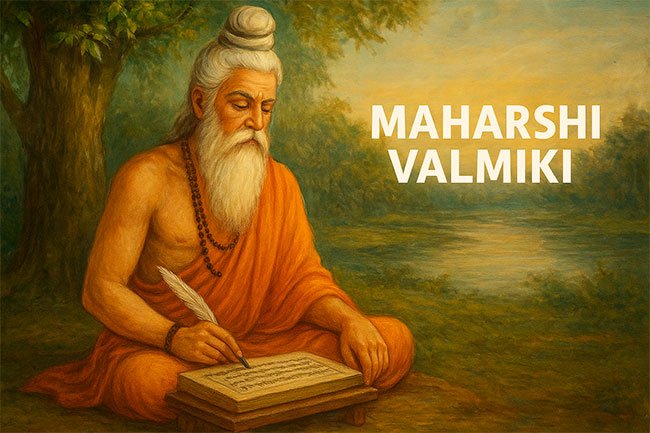
Maharshi Valmiki is remembered as one of the most respected sages in Indian tradition. He is widely known as the Adikavi, meaning the first poet, because he is considered the composer of the Ramayana, one of the greatest epics of ancient India. Although many stories describe his early life in different ways, they all highlight his deep transformation and his rise to spiritual wisdom.
Origin Stories of Maharshi Valmiki
The early life of Maharshi Valmiki is described in many traditional stories, and one of the most important among them is his encounter with the sage Narada. According to these accounts, Valmiki did not begin life as a saint. He lived in the forest with his family, and to support them, he believed that stopping travelers and taking their belongings was his only means of survival.
One day, he attempted to rob Sage Narada, unaware of who he was. Narada calmly asked a question that changed everything: would his family share the consequences of his actions? Valmiki went home to ask them, and their honest reply made him realize that although they relied on him, they would not share the results of any wrongdoing. This moment of truth deeply affected him.
Narada then guided him to turn toward meditation and inner reflection. Valmiki followed this advice wholeheartedly, and over time, his mind shifted toward peace, discipline, and self-awareness. Another well-known story says that during his long meditation, ants built mounds around him, and from the word “valmika,” meaning anthill, came the name he is known by today.
These stories highlight a powerful message: a sincere change of heart can transform a person completely. Valmiki’s journey shows how reflection, effort, and guidance can lead to great wisdom.
Valmiki and the Creation of the Ramayana
The Ramayana is considered Valmiki’s greatest work. It is said that a touching moment in nature inspired him to create the first poetic verse. That verse later grew into the grand epic that narrates the life of Lord Rama. The Ramayana goes beyond storytelling. It reflects values such as responsibility, devotion, courage, and emotional depth. Valmiki’s ability to describe characters and events with clarity made the epic meaningful for people for thousands of years.
Valmiki’s Role as a Teacher
Valmiki’s ashram is often described as a peaceful place filled with learning. Sita is believed to have stayed there during her exile, and her sons, Lava and Kusha, were born and raised under his guidance. Valmiki taught them the Ramayana, and the twins later recited it in front of Rama himself. This shows Valmiki not only as a poet but also as a teacher who helped shape young minds.
Teachings and Philosophy of Maharshi Valmiki
Valmiki’s teachings highlight the value of truth, compassion, and self-awareness. His own life shows that transformation is always possible when a person decides to walk the right path. The Ramayana reflects these ideas by emphasizing patience, commitment to duty, and moral strength.
Legacy of Maharshi Valmiki
Valmiki’s influence continues to be seen in literature, culture, and spiritual traditions. Being known as the Adikavi places him at the beginning of India’s poetic heritage. His epic inspired countless retellings, performances, and teachings across different cultures. Temples and festivals dedicated to him keep his memory alive even today.
Why Maharshi Valmiki Still Matters Today
The story of Valmiki shows how deeply inner transformation can shape a person’s life. His teachings and the messages of the Ramayana continue to guide people in making thoughtful choices, developing strong values, and facing challenges with confidence. His life and work remain timeless, offering wisdom that still feels relevant in the modern world.
You may also like to read –
Ramkrishna Paramhans — The Divine Messenger of Devotion & Spiritual Awakening
Sant Tukaram – The Saint Who Turned Suffering Into Divine Love